
Designing an Interpretive Structural Model of Factors Affecting the Development of Food Ecotourism: A Case Study of Qeshm Island
Keywords:
Development, Gastronomic Ecotourism, Tourism, Qeshm, Structural InterpretationAbstract
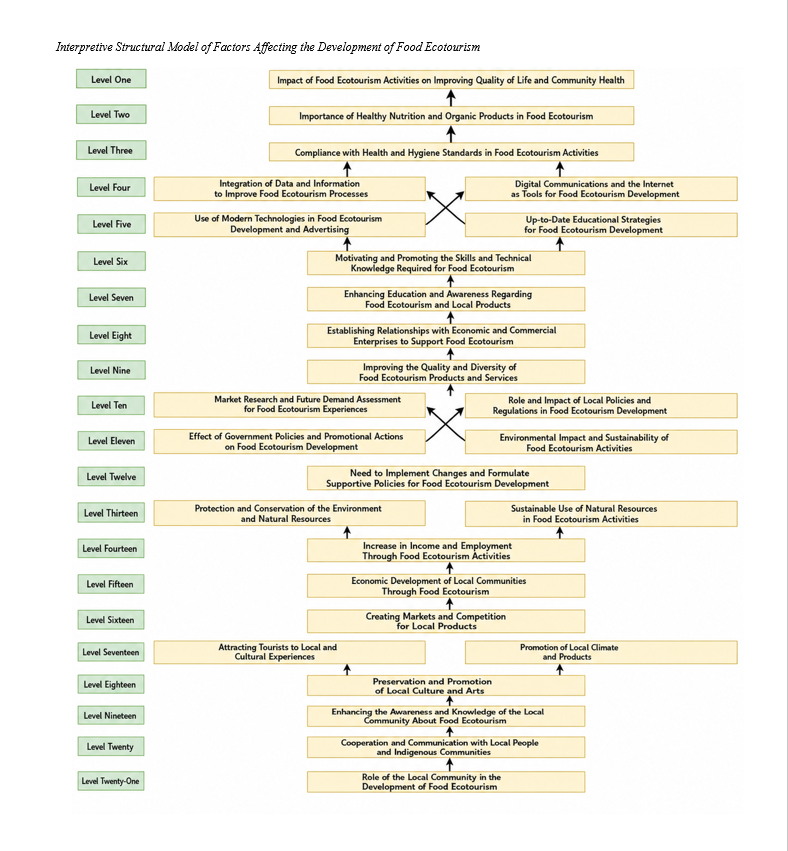
This study investigates the interpretive structural model of factors affecting the development of food ecotourism on Qeshm Island. The research method is descriptive-survey in nature and applied in terms of purpose. The research population consisted of tourism managers and experts, and a sample of 30 participants was selected through convenience sampling. The data collection instrument was a questionnaire comprising 27 items and covering the dimensions of social, cultural, economic, environmental, political and structural, economic and marketability, educational and human resource development, technological and innovation, and health and quality of life factors. Data analysis was conducted using the Interpretive Structural Modeling (ISM) approach. The findings indicate that food ecotourism activities are among the key factors contributing to the improvement of community health and quality of life, which were positioned at the first level of the model. The importance of healthy nutrition and organic products in food ecotourism was identified as one of the influential factors in its development at the second level. In addition, compliance with health and hygiene standards in food ecotourism activities was recognized as another influential factor in the development of this sector and was placed at the third level. Environmental impacts and the sustainability of food ecotourism activities, as an independent variable, play a highly significant role in the development of this sector. This study clearly demonstrates that food ecotourism not only contributes to enhancing individuals’ quality of life and public health, but also supports environmental conservation and economic sustainability.
References
Bagheri, A., Rousta, A., Forozandeh, L., & Asayesh, F. (2023). Presenting the Marketing Model of Health Tourism Development in Tehran Using Grounded Theory Method. Urban Economics and Planning, 4(3), 6-21. https://doi.org/10.22034/uep.2023.401857.1373
Bayat, O. (2023). Identifying and Prioritizing Factors Affecting the Development of Food Tourism in Yazd City. Interdisciplinary Studies in Marketing Management, 2(3), 128-144.
Bu, Y., Parkinson, J., & Thaichon, P. (2021). Digital Content Marketing as a Catalyst for eWOM in Food Tourism. Australasian Marketing Journal, 29(2), 142-154. https://doi.org/10.1016/j.ausmj.2020.01.001
Durmaz, Y., ÇAyiraĞAsi, F., & ÇOpuroĞLu, F. (2022). The Mediating Role of Destination Satisfaction Between the Perception of Gastronomy Tourism and Consumer Behavior During COVID-19. International Journal of Gastronomy and Food Science, 28, 100525. https://doi.org/10.1016/j.ijgfs.2022.100525
Dursun, F. (2024). A Conceptual Study on the Role of Street Food in Gastronomic Tourism. Journal of Hospitality and Tourism Issues, 6(2), 195-213. https://doi.org/10.51525/johti.1554128
Ebrahimi, Z., Tabavar, A. A., & Salarzahi, H. (2023). Investigating the impact of innovative digital marketing on food tourism components in eco-tourism of South Khorasan Province. In 6th National Conference on the Development of New Technologies in Management, Accounting, and Computer Science,
Etale, L. M., & Uranta, K. G. (2022). Digital marketing and consumer behavioral pattern of fast-food business enterprises in Yenagoa, Bayelsa State. European Journal of Hospitality and Tourism Research. https://www.google.com/url?sa=t&source=web&rct=j&opi=89978449&url=https://eajournals.org/ejhtr/vol10-issue-1-2022/digital-marketing-and-consumer-behavioral-pattern-of-fast-food-business-enterprises-in-yenagoa-bayelsa-state/&ved=2ahUKEwiZpqCU9OGOAxUbhIkEHR4KPFYQFnoECBgQAQ&usg=AOvVaw18p7hCRm-CuVdUVT2IY6kF
Garcia Henche, B. (2018). Urban experiential tourism marketing: Use of social media as communication tools by the food markets of Madrid. Journal of Tourism Analysis: Revista de Análisis Turístico. https://doi.org/10.1108/JTA-01-2018-0002
Ishmael-Robertson, C. A. (2018). What are the key advances in human resource development that tourism in Guyana needs by 2025? Worldwide Hospitality and Tourism Themes, 10(5), 605-610. https://doi.org/10.1108/WHATT-05-2018-0034
Jalalian, S. E., Saidi, M., & Waysian, M. (2019). Brand Equity Analysis of Urban Tourism Destination (Case Study: Marivan City). Geographical Urban Planning Research (GUPR), 7(2), 333-348. https://doi.org/10.22059/jurbangeo.2019.270214.1007
Juliana, J., Hubner, I. B., Indra, F., Sianipar, R., Sitorus, N. B., & Djakasaputra, A. (2024). Combining Foodscape and Touristscape: International Tourism Marketing for Singapore and Batam. Jurnal Ilmiah Global Education, 5(2), 1651-1669. https://doi.org/10.55681/jige.v5i2.2600
Kaya, A. Ş. (2023). Nutrition and Dietetics Practices in Health Tourism. In O. Doğan (Ed.), Global Perspectives on the Opportunities and Future Directions of Health Tourism (pp. 248-264). IGI Global. https://doi.org/10.4018/978-1-6684-6692-6.ch010
Kim, S. (2025). Generation Z's Michelin Choices: Survey and Big Data Insights Into Thailand's Michelin‐Starred Restaurants. International Journal of Tourism Research, 27(5). https://doi.org/10.1002/jtr.70135
Kuang, T. Y., Yang, D., & Zou, D. (2024). The impact of transparent packaging: how transparent packaging for organic foods affects tourists' green purchasing behavior. Nutrition and Sustainable Diets. https://doi.org/10.3389/fnut.2024.1328596
Listiani, W., Ningdyah, A. E. M., & Rohaeni, A. J. (2026). Desire to Revisit: Memorable Experiences Drive Domestic Tourists to Return to Bali. Jurnal Kajian Bali (Journal of Bali Studies), 14(1), 147-168. https://doi.org/10.24843/jkb.2024.v14.i01.p07
Magdy, A. (2024). Antecedents and Consequences of the Creative Food Tourism Experience: Brand Equity Insights. Tourism and Hospitality Research. https://doi.org/10.1177/14673584241276083
Mohanty, P. P., Rout, H. B., & Sadual, S. K. (2020). Food, Culture and Tourism: A Gastronomy Trilogy Enhancing Destination Marketing, Case Study of Odisha, India. International Journal of Tourism and Hospitality in Asia Pasific, 3(1), 15-30. https://doi.org/10.32535/ijthap.v3i1.721
Okumuş, B., Mehraliyev, F., Ma, F., & Köseoğlu, M. A. (2020). Intellectual Connections in Food Tourism Literature: A Co‐citation Approach. International Journal of Tourism Research, 23(2), 220-237. https://doi.org/10.1002/jtr.2409
Pavlidis, G., & Μαρκαντωνάτου, Σ. (2020). Gastronomic Tourism in Greece and Beyond: A Thorough Review. International Journal of Gastronomy and Food Science, 21, 100229. https://doi.org/10.1016/j.ijgfs.2020.100229
Pilis, W., Kabus, D., & Miciuła, I. (2022). Food Services in the Tourism Industry in Terms of Customer Service Management: The Case of Poland. Sustainability, 14(11), 6510. https://doi.org/10.3390/su14116510
Rana, J. C., & Bisht, I. S. (2023). Reviving Smallholder Hill Farming by Involving Rural Youth in Food System Transformation and Promoting Community-Based Agri-Ecotourism: A Case of Uttarakhand State in North-Western India. Sustainability, 15(11), 8816. https://doi.org/10.3390/su15118816
Salisu, B., & Waziri, M. S. (2024). Effects of visual brand identity on perceived healthiness of fast-food among higher education students. Journal of Social, management and tourism letter, 2024, 1-14.
Stalmirska, A. M. (2020). Cultural globalization and food in urban destination marketing. Tourism Geographies, 1-19.
Sulaiman, A. I., Putri, D. D., Wijayanti, I. K. E., Windiasih, R., & Weningsih, S. (2023). Community-Based Tourism Village Development in Health Food Security and Sustainable Agribusiness. Res Militaris, 13(2), 170-184.
TingYue, K., Dajun, Y., & Dingxia, Z. (2024). The impact of transparent packaging: how transparent packaging for organic foods affects tourists’ green purchasing behavior. Nutrition and Sustainable Diets. https://doi.org/10.3389/fnut.2024.1328596
Downloads
Publication Timeline
- Submitted
- Revised
- Accepted
Issue
Section
License
Copyright (c) 2026 Hamidreza Sadeghi (Author); Ali Yaghoubipoor; Mohammad Montazeri (Author)

This work is licensed under a Creative Commons Attribution-NonCommercial 4.0 International License.