Development of Tourism Accounting from the Perspective of Identified Consequences within Commercial Firms Active in This Industry
Keywords:
Tourism accounting, interpretive ranking, sustainabilityAbstract
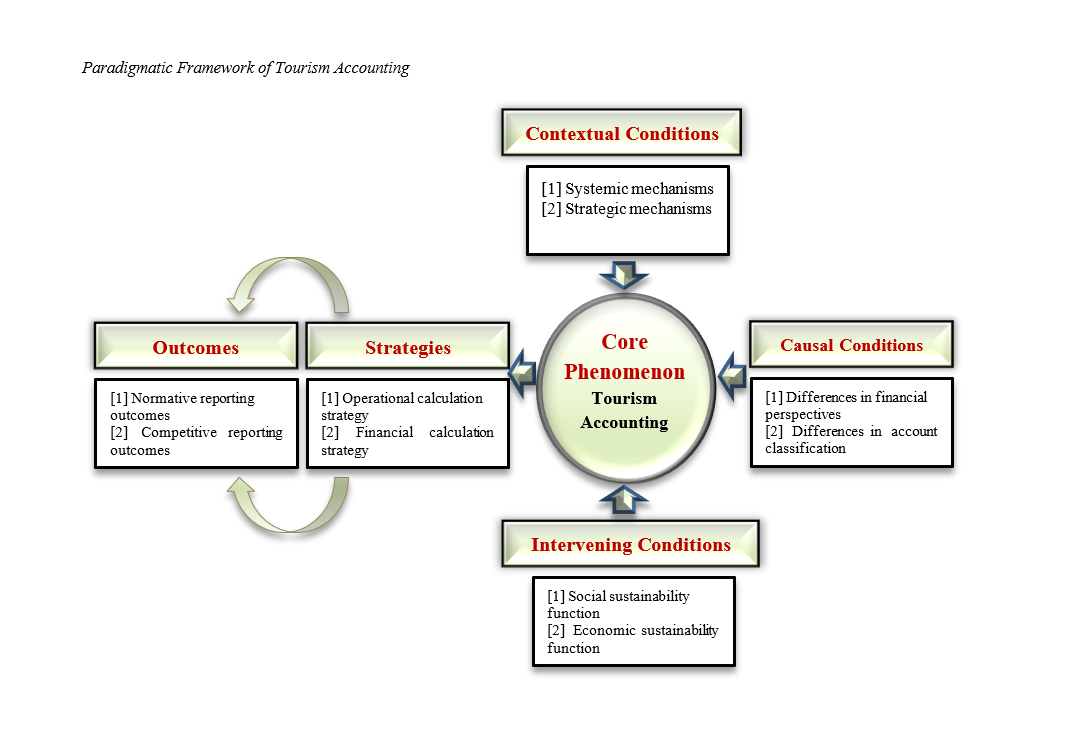
The objective of this study is to develop tourism accounting from the perspective of identified consequences within commercial firms operating in this industry. In terms of methodology, the present study can be considered exploratory, developmental, and mixed-method. In this study, through the use of interview tools and three stages of grounded theory coding, an initial attempt was made to present a paradigmatic model based on the approach of Strauss and Corbin (1998). After assessing the reliability of the identified dimensions using the Delphi technique, the second phase of the study focused on the identified consequences of tourism accounting. Specifically, it aimed to determine the most central dimension influencing the expansion of accounting functions in this industry, which, based on economic system policymaking, can be recognized as a reliable output. The qualitative findings of this study indicate the presentation of a paradigmatic model based on 50 conceptual themes and 10 core categories, forming five dimensions: causal conditions, contextual conditions, intervening conditions, strategies, and consequences of tourism accounting development. In the quantitative section of the study, it was found that the consequence of “more comprehensive disclosure of internal control weaknesses” (I₉) is the most significant outcome expected from the development of tourism accounting at the firm level in this industry, such that broader disclosure of performance-related information can facilitate the achievement of sustainability.
References
Abby, L., & Geoffrey, W. (2006). Employment and Development: A Developing Country Perspective. Tourism Management, 27(2), 159-170.
Adams, D. (2006). Management Accounting for the Hospitality, Tourism and Leisure Industries: A Strategic Approach (2 ed.). Thomson Learning.
Aristia Prayudi, M., Sujana, E., Yulianita, D. N. W., & Wiguna, G. N. H. (2019). The Research and Development Study of Tourism Accounting Dictionary Proceedings of the International Conference on Tourism, Economics, Accounting, Management, and Social Science,
Azmi, Z., & Harti, I. D. (2021). The Effect of Strategic Management Accounting and Organizational Capability on Organizational Performance. Ekonomis: Journal of Economics and Business, 5(1), 266-276. https://doi.org/10.33087/ekonomis.v5i1.309
Bartolini, A., Di Gennaro, V., Reas, V., Mascolo, R. A., La Notte, A., Capriolo, A., & Ferrini, S. (2024). Ecosystem Accounting for Marine-Based Tourism Provided by Posidonia oceanica in Italy. One Ecosystem, 9(2), 1-23. https://doi.org/10.3897/oneeco.9.e129751
Bhatt, M. S., & Nunjal, P. (2013). Social Accounting Matrix to Study the Socio-Economic Linkages of the Tourism Sector: A Case Study of India. Indian Economic Review, 48(2), 381-412.
Hosami Naqshbandi, M., Charehjou, F., Ahmadi Dehrashid, A., & Ketabollahi, K. (2021). Urban Tourism Development Framework with a City Branding Approach: The Case of Sanandaj. Tourism and Development, 10(2), 34-51.
Joo, D., Woosnam, K. M., Strzelecka, M., & Boley, B. B. (2020). Knowledge, Empowerment, and Action: Testing Empowerment Theory in a Tourism Context. Journal of Sustainable Tourism, 28(1), 69-85. https://doi.org/10.1080/09669582.2019.1675673
Karagiorgos, T., Drogalas, G., Christodoulou, P., & Pazarskis, M. (2006). The Crucial Importance of Accounting in Tourism Business.
Koens, A., & Wood, R. C. (2017). An Analysis of International Employment Levels in Hospitality Occupations Using Secondary Statistics. International Journal of Tourism Research, 19(5), 496-504.
Lordkipanidze, M., Brezet, H., & Backman, M. (2005). The Entrepreneurship Factor in Sustainable Tourism Development. Journal of Cleaner Production, 13(8), 787-798.
Moncarz, P. E., & Barone, S. V. (2020). Rising Commodity Prices and Welfare in Brazil: A Simulation of Medium-Term Effects Using a SAM Price Model. International Journal of Emerging Markets, 15(5), 1029-1060. https://doi.org/10.1108/IJOEM-02-2019-0091
Nugroho, A., & Verikios, G. (2025). Tourism- versus Non-Tourism-Led Growth: Which Is Superior? Annals of Tourism Research, 114(2), 1-28. https://doi.org/10.1016/j.annals.2025.104000
Oktaviani, L. G. A. (2022). The Role of Accountants in Supporting Sustainable Development in the Digital Era. Journal Akuntansi Dan Ekonomi, 7(3), 56-67. https://doi.org/10.29407/jae.v7i3.18492
Oktayani, M., Dewi, N. M. S., & Kewa, M. S. A. (2024). Strategic Role of Modern Accounting in Improving Tourism Management Effectiveness. Journal of Entrepreneurial and Business Diversity, 2(4), 333-343. https://doi.org/10.38142/jebd.v2i4.288
Pupovac, S., & Nikidehaghani, M. (2024). Sustainable Development and First Nations Values: A Multidimensional Accounting Approach for Mining Proposals. Meditari Accountancy Research. https://doi.org/10.1108/MEDAR-04-2023-1986
Santos, S. (2012). A SAM (Social Accounting Matrix) Approach to the Policy Decision Process (Working Papers Department of Economics 2012/28, Issue.
Sargazi, S., Hasanvand, D., & Asayesh, H. (2020). Strategic Analysis of Rural Tourism Industry Development under Iran's Economic Conditions. Tourism Space Journal, 9(36), 55-76.
Siregar, H. A. (2023). Tourism Accounting: A Guide to Preparing Financial Statements for Tourism Service Businesses (Vol. 2). Penerbit Taman Karya.
Song, H., Dwyer, L., Li, G., & Cao, Z. (2012). Tourism Economics Research: A Review and Assessment. Annals of Tourism Research, 39(3), 1653-1682.
Stabler, M. J., Papatheodorou, A., & Sinclair, M. T. (2010). The Economics of Tourism (2 ed., Vol. 2). Routledge. https://doi.org/10.4324/9780203864272
Suparman, M. V. (2023). Tourism Economics: Theory, Models, Concepts, and Sustainable Tourism Development Strategies. Publica Indonesia Utama.
Tang, G., Chiclana, F., Lin, X. C., & Liu, P. (2020). Interval Type-2 Fuzzy Multi-Attribute Decision-Making Approaches for Evaluating the Service Quality of Chinese Commercial Banks. Knowledge-Based Systems, 193(2), 53-78. https://doi.org/10.1016/j.knosys.2019.105438
Vasiljevic, M., Radovanovic, S., Glisovic, G., & Mihailovic, N. (2015). Tax and Accounting Treatment of Unique Tourism Service. Turisticko Poslovanje, 2(1), 1-19. https://doi.org/10.5937/TurPos1515017V
Xian, S., Li, C., Feng, M., & Li, Y. (2024). Double-Level Optimal Fuzzy Association Rules Prediction Model for Time Series Based on DTW-iL1 Fuzzy C-Means. Expert Systems with Applications, 251(2), 112-130. https://doi.org/10.1016/j.eswa.2024.123959
Yaghoubi Manzari, P., & Aghamiri, S. O. (2017). Identifying Sustainable Development Strategies for Iran's Tourism Industry Using the Meta-SWOT Technique and ارائه Suitable Solutions. Commercial Reviews Bimonthly, 15(86), 1-15.
Yuniarta, G. A. (2015). Development of Hospitality Accounting Dictionary Software. Journal Sains dan Teknologi, 4(1), 58-73. https://doi.org/10.23887/jst-undiksha.v4i1.4927
Zlati, M. L., Ionescu, R. V., & Antohi, V. M. (2021). Impact Study on Social Accounting Matrix by Intrabusiness Analysis. International journal of environmental research and public health, 18(23), 15-47. https://doi.org/10.3390/ijerph182312547
Downloads
Publication Timeline
- Submitted
- Revised
- Accepted
Issue
Section
License
Copyright (c) 2026 Rezvaneh Sadat Seyedrezaei , Hasan Valian, Mohammadreza Abdoli , Maryam Shahri (Author)

This work is licensed under a Creative Commons Attribution-NonCommercial 4.0 International License.