The Effect of Government Size, Resource Governance, and Institutional Quality on the Human Development Index in Iran Using the Nonlinear Autoregressive Distributed Lag (NARDL) Threshold Approach
Keywords:
Human Development Index, Government Size, Institutional Quality, Resource Governance, Financial DevelopmentAbstract
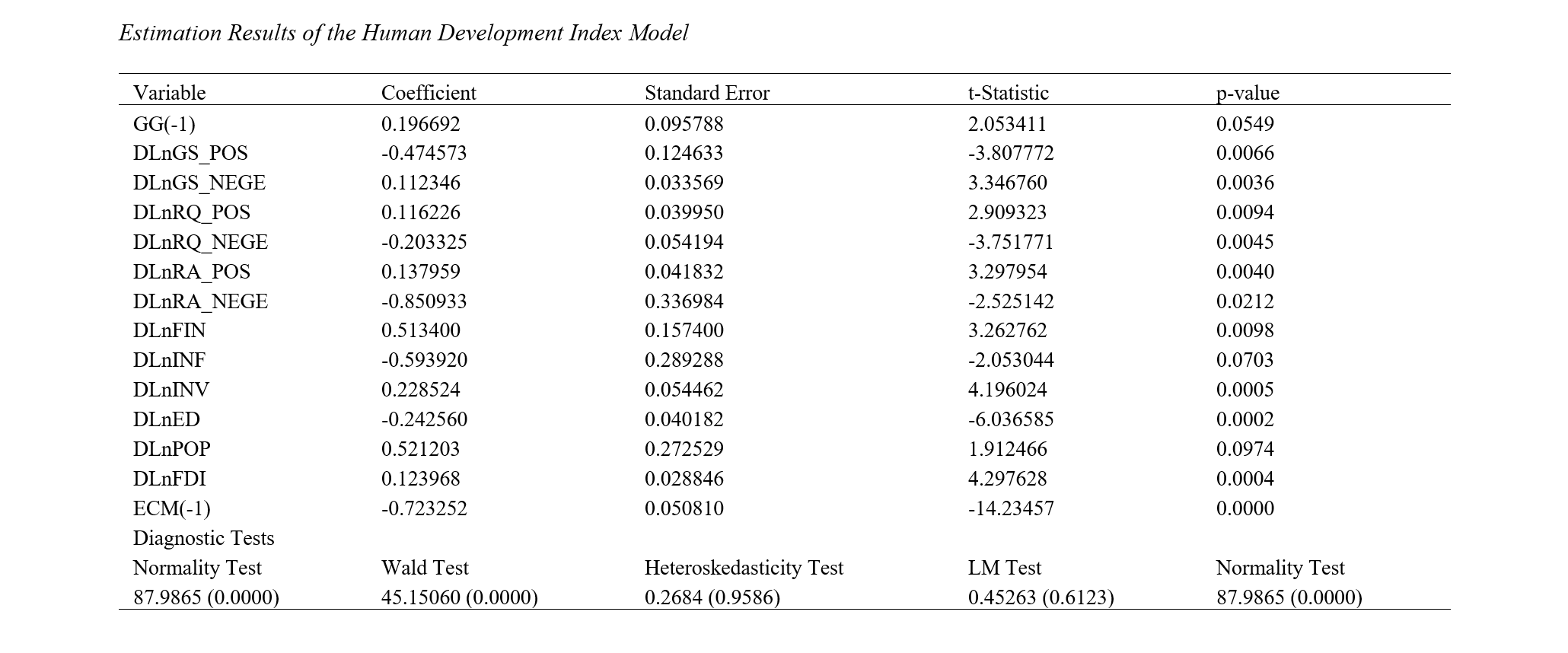
This study investigates the effects of government size, resource governance, and institutional quality on the Human Development Index (HDI) in Iran using the nonlinear autoregressive distributed lag (NARDL) threshold approach to estimate long-run coefficients, short-run dynamics, and the error correction mechanism (ECM). The short-run estimation results indicate that negative shocks to government size exert a positive effect, while positive shocks have a negative effect on the Human Development Index; thus, government size influences human development asymmetrically. Furthermore, positive shocks to institutional quality and resource governance have a positive effect, whereas negative shocks exert a negative effect on the Human Development Index, highlighting the direct and asymmetric role of these variables in human development. Financial development, physical investment, population, and foreign direct investment demonstrate positive and statistically significant effects on human development, while inflation and external debt exert negative impacts. The ECM coefficient, estimated at -0.723252, indicates a high speed of adjustment from short-run disequilibrium toward long-run equilibrium and confirms model convergence. Diagnostic tests, including the normality test, Wald test for symmetry, heteroskedasticity test, serial correlation test, and functional form specification test, confirm the validity of the model and indicate the absence of statistical issues. The Banerjee and Dolado test also confirms the existence of a long-run relationship (cointegration) among the variables. Long-run coefficients reveal a negative effect of government size and inflation rate, and a positive effect of institutional quality, resource governance, financial development, investment, population, and foreign direct investment on the Human Development Index, all statistically significant at the 95% confidence level. Finally, structural stability tests (CUSUM and CUSUMSQ) confirm the stability of the model and indicate the absence of structural breaks. The findings emphasize the importance of considering the asymmetric effects of economic and institutional shocks and their critical role in enhancing the Human Development Index.
References
Ayoade, O. S., Orisadare, M. A., Adediwura, M. O., & Ofino, E. E. (2023). Human development and institutional quality in Nigeria: Effects of institutional quality on poverty and human development. International Journal of Research and Innovation in Social Science, 7(10), 2071-2085.
Friedman, E., & Denti, A. (2022). Government size and economic growth: New evidence from dynamic panel data models. Economic Modelling, 107, 105644.
Ghasemi, M., & Ahmadi, F. (2023). Asymmetric Effects of Government Size on the Human Development Index: A Case Study of Iranian Provinces. Journal of Iran Economy, 15(1), 98-125.
Jalali, A., & Sadeghi, S. (2022). The Impact of Oil Revenues and Institutional Quality on Human Development in Iran. Energy Economics Quarterly, 9(2), 120-145.
Jungo, M. (2022). Institutions and economic development: New measurements and evidence. Empirical Economics, 65(3), 1693-1728.
Kazemi, Z., & Nazari, A. (2022). The Role of Corruption and Institutional Transparency in Improving the Human Development Index in Iran. Public Policy Quarterly, 6(3), 55-80.
Mirzaei, A., AlKhazali, O., Aguir, I., & Aguir, W. (2026). The impact of FinTech credit on growth in capital expenditure: Evidence from Chinese manufacturing firms. International Review of Economics & Finance, 106, 104911. https://doi.org/10.1016/j.iref.2026.104911
Mohammadi, A., & Hosseini, R. (2023). Investigating the Effects of Government Size on Human Development in Iran with an Institutional Approach. Journal of Economic Development and Planning, 12(3), 110-135.
Mousavi, H., & Bahrami, Z. (2022). Government Size and Human Development in Iran: A Panel Data Study. Journal of Economics and Management of Iran, 7(1), 30-55.
Najafi, S., & Karimi, A. (2023). The Role of Natural Resource Governance and Institutional Quality in Human Development of Iranian Provinces. Natural Resource Economics Quarterly, 5(2), 51-74.
Rafiei, N., & Sharifi, R. (2022). Institutional Quality, Resource Governance, and Human Development in Iran’s Oil-Rich Regions. Iranian Economic Research Quarterly, 11(2), 80-105.
Rahimi, M., & Bagheri, M. (2022). The Relationship Between Natural Resource Governance, Government Size, and Human Development in Iran. Journal of Iran Development Economics, 10(4), 45-70.
Rodrik, D. (2021). Institutions for high-quality growth: What they are and how to acquire them. Journal of Economic Perspectives, 35(2), 1-25.
Sachs, J. D., & Warner, A. M. (2019). The curse of natural resources. European Economic Review, 88, 114-121.
Singh, R. (2023). Institutions and economic growth: The role of financial inclusion, public spending on education and the military. Emerald Insight.
Soltani, N., & Hosseini, V. (2022). Corruption and Institutional Inefficiency and Their Impact on Human Development in Iran. Iranian Development Studies Journal, 8(2), 70-95.
Sun, D., Zhou, Y., Ali, Q., & Khan, M. T. I. (2025). The role of digitalization, infrastructure, and economic stability in tourism growth: A pathway towards smart tourism destinations. Natural Resources Forum, 49(2), 1308-1329. https://doi.org/10.1111/1477-8947.12437
Taghavi, M. (2025). Analyzing the Effect of Banking Financial Facilities on the Growth of Small Enterprises in Iran. 12th International Conference on Management, Accounting, Banking, and Economics in Iran, Mashhad,
Tan, P. H. P., Wilson, N., & Novembri, C. S. R. (2025). Entrepreneurial Mindset for Sustainable Economic Growth: Gen Z Jabodetabek Case. Indonesian Journal of Sustainability Accounting and Management, 9(1). https://doi.org/10.20448/ijsam.v9i1.7278
Downloads
Publication Timeline
- Submitted
- Revised
- Accepted
Issue
Section
License
Copyright (c) 2026 Marjan Gholamzadeh (Author); Alireza Daghighi; Majid Afsharirad, Roya Seifipour (Author)

This work is licensed under a Creative Commons Attribution-NonCommercial 4.0 International License.