Presenting a Process Model of Lean Manufacturing in Industry 4.0 Based on a Mixed-Methods Research Approach
Keywords:
Lean manufacturing, production process, intelligence, dairy industry, Industry 4Abstract
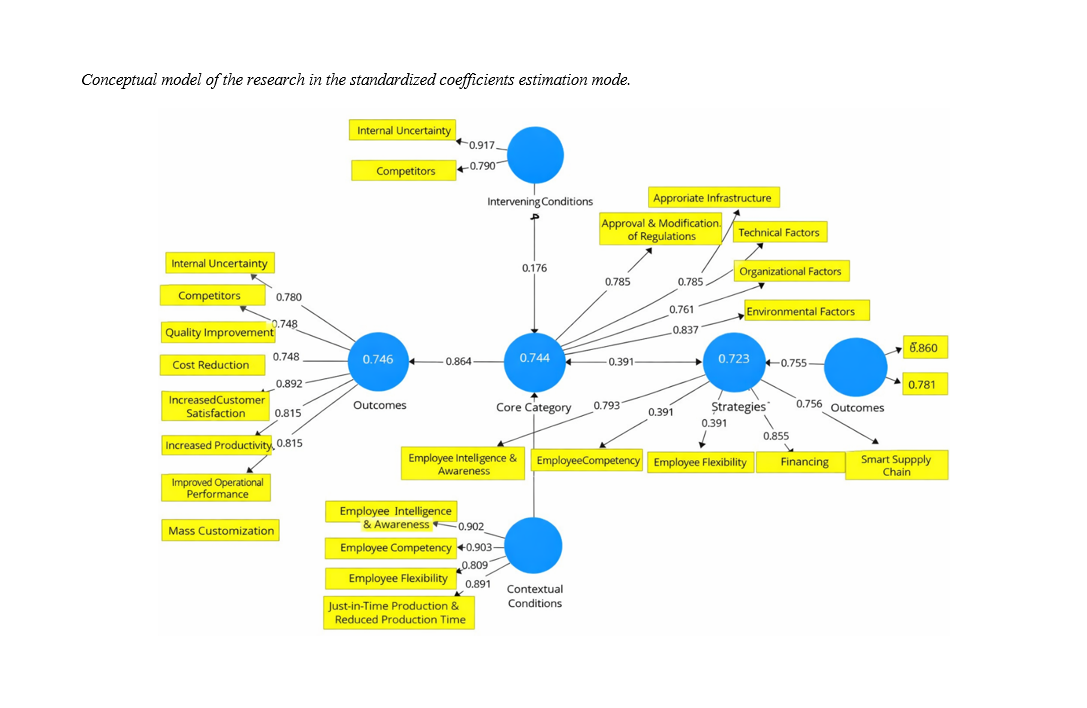
This study aims to present a process model of lean manufacturing in Industry 4.0 based on a mixed-methods research approach. In terms of purpose, the study is applied, and in terms of data collection, it is classified as mixed-methods research (qualitative–quantitative). The statistical population in the qualitative section included university faculty members, experts in the fields of technology and manufacturing, as well as senior managers of production and research and development in the dairy industry. In the quantitative section, the population consisted of all managers and employees of the production and information technology departments of dairy manufacturing companies in Tehran. The sample size in the qualitative section was determined based on theoretical saturation (10 participants) using purposive sampling, while in the quantitative section, a sample of 361 participants was estimated using stratified random sampling. Data collection instruments included interviews in the qualitative section and a researcher-developed questionnaire in the quantitative section. The validity and reliability of the questionnaire were confirmed. Data analysis was conducted using SmartPLS 3 software. The results led to the identification of 28 components and 112 indicators. The variables of lean quality management, smart supply chain, lean process management, smart customer orientation, and smart human resources were considered as the core categories. The variables of technical factors, environmental factors, organizational factors, and operational factors were identified as causal conditions. The variables of employee competency, employee flexibility, employee knowledge management, and employee intelligence and awareness were identified as contextual conditions. The variables of internal uncertainty and competitors were considered as intervening conditions. The variables of financing, downsizing and mergers, employee empowerment, appropriate infrastructure, and the approval and modification of regulations were identified as strategies. Finally, the variables of cost reduction, increased productivity, just-in-time production and reduced production time, quality improvement, improved operational performance, mass customization, flexibility, and increased customer satisfaction were identified as outcomes.
References
Abbasi Meybodi, Z., & Mohibi, H. (2023). The Role of the Fourth Industrial Revolution in the Development of Lean and Agile Production Systems. Second International Conference on Business Economics and Management with a Focus on Knowledge-Based Development. https://civilica.com/doc/1780539/
Bavarzad, B., & Daniali, S. (2022). Examining the Mutual Impact of Lean Production and Industry 4.0. Third International Conference on Challenges and Innovative Solutions in Industrial Engineering, Management, and Accounting. https://civilica.com/doc/1564458/
Buer, S. V., Strandhagen, J. O., & Chan, F. T. (2018). The Link Between Industry 4/1 and Lean Manufacturing: Mapping Current Research and Establishing a Research Agenda. International Journal of Production Research, 56(8), 2224-2241. https://doi.org/10.1080/00207543.2018.1442945
Ciano, M. P., Dallasega, P., Orzes, G., & Rossi, T. (2021). One-to-one relationships between Industry 4.0 technologies and Lean Production techniques: a multiple case study. International Journal of Production Research, 59(5), 1386-1410. https://doi.org/10.1080/00207543.2020.1821119
Danesh Naroui, K. (2021). Investigating the Simultaneous Application of Lean Production and Digitalization on Improving Operational Performance. Fourth National Conference on New Technologies in Electrical Engineering, Computer Science, and Mechanics in Iran. https://civilica.com/doc/1292948/
Dombrowski, U., Richter, T., & Krenkel, P. (2017). Interdependencies of Industrie 4/1 & Lean Production Systems: A Use Cases Analysis. Procedia Manufacturing, 11, 1161-1168. https://doi.org/10.1016/j.promfg.2017.07.217
Eshaghi Kheyroudkenar, M. (2023). Applications of Artificial Intelligence in Production Management of Textile Units. Sixth International Conference on New Developments in Management, Economics, and Accounting. https://civilica.com/doc/1861518/
Hopp, W. J. (2018). Positive Lean: Merging the Science of Efficiency with the Psychology of Work. International Journal of Production Research, 56(1-2), 328-413. https://doi.org/10.1080/00207543.2017.1387301
Kamble, S., Gunasekaran, A., & Dhone, N. C. (2023). Industry 4/1 and Lean Manufacturing Practices for Sustainable Organisational Performance in Indian Manufacturing Companies. International Journal of Production Research, 58(5), 1312-1337. https://doi.org/10.1080/00207543.2019.1630772
Kolberg, D., Knobloch, J., & Zuhlke, D. (2017). Towards a Lean Automation Interface for Workstations. International Journal of Production Research, 55(11), 2845-2856. https://doi.org/10.1080/00207543.2016.1223384
Kovacs, G. (2020). Combination of Lean Value-Oriented Conception and Facility Layout Design for Even More Significant Efficiency Improvement and Cost Reduction. International Journal of Production Research, 58(11), 2216-2236. https://doi.org/10.1080/00207543.2020.1712490
Kumar, N., Singh, A., Gupta, S., Kaswan, M. S., & Singh, M. (2024). Integration of Lean manufacturing and Industry 4/1: a bibliometric analysis. The TQM Journal, 36(1), 244-264. https://doi.org/10.1108/TQM-07-2022-0243
Moeuf, A., Lamouri, S., Pellerin, R., Tamayo-Giraldo, S., Tobon-Valencia, E., & Eburdy, R. (2020). Identification of Critical Success Factors, Risks and Opportunities of Industry 4/1 in SMEs. International Journal of Production Research, 58(5), 1384-1411. https://doi.org/10.1080/00207543.2019.1636323
Rosin, F., Forget, P., Lamouri, S., & Pellerin, R. (2020). Impacts of Industry 4/1 technologies on Lean principles. International Journal of Production Research, 58(6), 1644-1661. https://doi.org/10.1080/00207543.2019.1672902
Rossini, M., Costa, F., Tortorella, G. L., & Portioli-Staudacher, A. (2019). The interrelation between Industry 4.0 and lean production: an empirical study on European manufacturers. The International Journal of Advanced Manufacturing Technology, 102, 3963-3976. https://doi.org/10.1007/s00170-019-03441-7
Rossini, M., Costa, F., Tortorella, G. L., Valvo, A., & Portioli-Staudacher, A. (2022). Lean Production and Industry 4.0 integration: how Lean Automation is emerging in manufacturing industry. The International Journal of Production Research, 60(21), 6430-6450. https://doi.org/10.1080/00207543.2021.1992031
Sancha, C., Wiengarten, F., Longoni, A., & Pagell, M. (2020). The Moderating Role of Temporary Work on the Performance of Lean Manufacturing Systems. International Journal of Production Research, 58(14), 4285-4315. https://doi.org/10.1080/00207543.2019.1651458
Silvestri, L., Gallo, T., & Silvestri, C. (2022). Which tools are needed to implement Lean Production in an Industry 4.0 environment? A literature reviews. Procedia Computer Science, 200(0), 1766-1777. https://doi.org/10.1016/j.procs.2022.01.377
Tortorella, G. L., Rossini, M., Costa, F., Portioli Staudacher, A., & Sawhney, R. (2021). A comparison on Industry 4.0 and Lean Production between manufacturers from emerging and developed economies. Total Quality Management & Business Excellence, 32(11-12), 1249-1270. https://doi.org/10.1080/14783363.2019.1696184
Valipour Khatir, M., Mohammadi Pour Omran, M., & Akbarzadeh, Z. (2022). Organizational Agility Indicators Using Fuzzy Multicriteria Decision-Making Techniques (Case Study: Iran Power Generation Development Organization). Journal of Innovation and Value Creation, 3(7). http://journalie.ir/fa/Article/305/FullText
Vlachos, I. P., Pascazzi, R. M., Zobolas, G., Repoussis, P., & Giannakis, M. (2023). Lean manufacturing systems in the area of Industry 4.0: A lean automation plan of AGVs/IoT integration. Production Planning & Control, 34(4), 345-358. https://doi.org/10.1080/09537287.2021.1917720
Wang, H. N., He, Q. Q., Zhang, Z., Peng, T., & Tang, R. Z. (2021). Framework of automated value stream mapping for lean production under the Industry 4.0 paradigm. Journal of Zhejiang University-SCIENCE A, 22(5), 382-395. https://doi.org/10.1631/jzus.A2000480
Downloads
Publication Timeline
- Submitted
- Revised
- Accepted
Issue
Section
License
Copyright (c) 2024 Seyed Hamidreza Pourtofigh (Author); Hossein Janatifar; Esmail Ameri Dehabadi (Author)

This work is licensed under a Creative Commons Attribution-NonCommercial 4.0 International License.