Identifying and Elaborating the Components of Humble Leadership in Nonprofit and Nongovernmental Organizations in Afghanistan: A Mixed Exploratory Study
DOI:
https://doi.org/10.61838/kman.jrmde.233Keywords:
Humble leadership, nongovernmental organizations, Afghanistan, exploratory factor analysis, Delphi techniqueAbstract
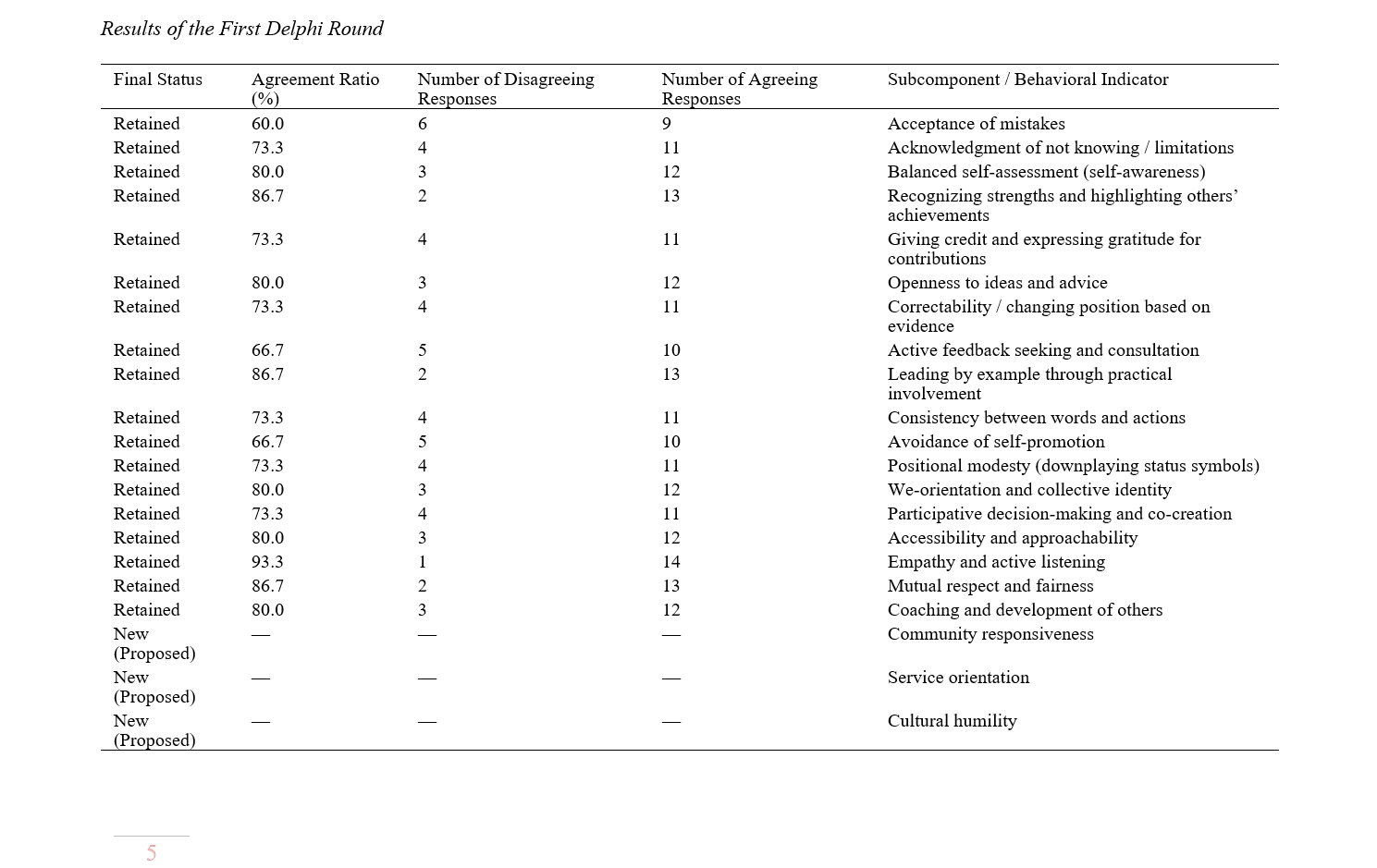
Nonprofit and nongovernmental organizations in Afghanistan operate within a context characterized by political insecurity, resource scarcity, and intense occupational pressures—conditions that highlight the critical need for leadership models that are humane, accountable, and capable of strengthening team cohesion. In the international literature, humble leadership has been introduced as one of the emerging positive leadership approaches; however, its behavioral dimensions have not yet been systematically articulated in a manner consistent with the cultural and organizational context of Afghanistan. The present study aimed to identify and contextualize the components and dimensions of humble leadership in Afghan NGOs. To this end, the research adopted a mixed exploratory design and was conducted in three stages: first, a systematic review of 32 scholarly articles and the extraction of 18 behavioral subcomponents; second, localization and refinement of these components through two rounds of the Delphi technique involving 15 experts, resulting in the addition of three new indicators—“community responsiveness,” “service orientation,” and “cultural humility”—and the confirmation of a total of 21 indicators; and third, the implementation of exploratory factor analysis on data collected from 295 NGO employees. The findings revealed that humble leadership in the studied context comprises five principal dimensions: “self-awareness and openness to correction,” “other-orientation and appreciation,” “respectful relationship orientation,” “authenticity and modest role modeling,” and “socio-cultural accountability.” The final dimension, which underscores the linkage between leader humility and social commitment as well as cultural sensitivity, represents the most significant indigenous innovation of the proposed model. This five-dimensional structure can serve as a foundation for the development of humble leadership measurement instruments and for the design of training interventions, as well as for the selection and evaluation of leaders in Afghan NGOs.
References
Ali, M., Li, Z., Khan, S., Shah, S. J., & Ullah, R. (2020). Linking humble leadership and project success: The moderating role of top management support with mediation of team-building. International Journal of Managing Projects in Business, 14(3), 545-571. https://doi.org/10.1108/IJMPB-01-2020-0032
Argandoña, A. (2015). Humility in management. Journal of Business Ethics, 132(1), 63-71. https://doi.org/10.1007/s10551-014-2311-8
Bakker, A. B., & Demerouti, E. (2007). The Job Demands-Resources model: State of the art. Journal of managerial psychology, 22(3), 309-328. https://doi.org/10.1108/02683940710733115
Brown, L. D., & Moore, M. H. (2001). Accountability, strategy, and international nongovernmental organizations. Nonprofit and Voluntary Sector Quarterly, 30(3), 569-587. https://doi.org/10.1177/0899764001303012
Chandler, M. M., Huang, L., & Hanges, P. J. (2022). A meta-analysis of humble leadership: Reviewing individual, team, and organizational outcomes of leader humility. The Leadership Quarterly, 33(5), 101660. https://doi.org/10.1016/j.leaqua.2022.101660
Chen, Y., Liu, B., Zhang, L., & Qian, S. (2018). Can leader "humility" spark employee "proactivity"? The mediating role of psychological empowerment. Leadership & Organization Development Journal, 39(3), 326-343. https://doi.org/10.1108/LODJ-10-2017-0307
Chintakananda, K., Diefendorff, J. M., Oc, B., Daniels, M. A., Greguras, G. J., & Bashshur, M. R. (2024). Leader expressed humility: Development and validation of scales based on a comprehensive conceptualization. Journal of Business Ethics, 192, 129-146. https://doi.org/10.1007/s10551-023-05523-9
Chiu, C. Y. C., Owens, B. P., & Tesluk, P. E. (2016). Initiating and utilizing shared leadership in teams: The role of leader humility, team proactive personality, and team performance capability. Journal of Applied Psychology, 101(12), 1705-1720. https://doi.org/10.1037/apl0000159
Denyer, D., & Tranfield, D. (2009). Producing a systematic review of the literature. In D. A. Buchanan & A. Bryman (Eds.), The SAGE Handbook of Organizational Research Methods (pp. 671-689). SAGE. https://psycnet.apa.org/record/2010-00924-039
Gagné, M., & Deci, E. L. (2005). Self-determination theory and work motivation. Journal of Organizational Behavior, 26(4), 331-362. https://doi.org/10.1002/job.322
Hobfoll, S. E. (1989). Conservation of resources: A new attempt at conceptualizing stress. American psychologist, 44(3), 513-524. https://doi.org/10.1037/0003-066X.44.3.513
Hobfoll, S. E. (2001). The influence of culture, community, and the nested-self in the stress process: Advancing conservation of resources theory. Applied Psychology, 50(3), 337-421. https://doi.org/10.1111/1464-0597.00062
Hobfoll, S. E. (2011). Conservation of resource caravans and engaged settings. Journal of Occupational and Organizational Psychology, 84(1), 116-122. https://doi.org/10.1111/j.2044-8325.2010.02016.x
Hook, J. N., Davis, D. E., Owen, J., Worthington, E. L., Jr., & Utsey, S. O. (2013). Cultural humility: Measuring openness to culturally diverse clients. Journal of counseling psychology, 60(3), 353-366. https://doi.org/10.1037/a0032595
Hu, J., Erdogan, B., Jiang, K., Bauer, T. N., & Liu, S. (2018). Leader humility and team creativity: The role of team information sharing, psychological safety, and power distance. Journal of Applied Psychology, 103(3), 313-323. https://doi.org/10.1037/apl0000277
Mohammadi, T., Zahed Babolan, A., Khaleghkhah, A., & Taghavi Ghareh Bolagh, H. (2025). Identifying Antecedents of Humble Leadership for Managers Using a Meta-Synthesis Approach. Public Management, 17(1), 187-220. https://search.ebscohost.com/login.aspx?direct=true&profile=ehost&scope=site&authtype=crawler&jrnl=20085877&AN=183714096&h=sV2Obshs%2By28GBUMtzyhTGh8R%2BJKqRf%2FnUHlh07ufTnBBmQWYxsRl7v7wMKw7%2BISLyzXBc0hPRjHgBZmZo9v%2BA%3D%3D&crl=c
Ou, A. Y., Tsui, A. S., Kinicki, A. J., Waldman, D. A., Xiao, Z., & Song, L. J. (2014). Humble chief executive officers' connections to top management team integration and middle managers' responses. Administrative Science Quarterly, 59(1), 34-72. https://doi.org/10.1177/0001839213520131
Owens, B. P., & Hekman, D. R. (2012). Modeling how to grow: An inductive examination of humble leader behaviors, contingencies, and outcomes. Academy of Management journal, 55(4), 787-818. https://doi.org/10.5465/amj.2010.0441
Owens, B. P., Johnson, M. D., & Mitchell, T. R. (2013). Expressed humility in organizations: Implications for performance, teams, and leadership. Organization Science, 24(5), 1517-1538. https://doi.org/10.1287/orsc.1120.0795
Owens, B. P., Wallace, A. S., & Waldman, D. A. (2015). Leader narcissism and follower outcomes: The counterbalancing effect of leader humility. Journal of Applied Psychology, 100(4), 1203-1213. https://doi.org/10.1037/a0038698
Pourdavood, M. R., & Aghighi, A. (2023). The Effect of Humble Leadership on Organizational Performance with the Mediating Role of Psychological Empowerment and Innovative Work Behavior. Proceedings of the Seventeenth International Conference on Management, Economics, and Development, Tehran.
Qaderi, M. (2021). Investigating the Mediating Role of Psychological Ownership and Knowledge Sharing Among Employees in the Relationship Between Humble Leadership and Employees' Job Performance Faculty of Administrative Sciences and Economics, Ferdowsi University of Mashhad].
Rego, A., Owens, B. P., Leal, S., Melo, A. I., Cunha, M. P., Gonçalves, L., & Ribeiro, P. (2017). How leader humility helps teams to be humbler, psychologically stronger, and more effective: A moderated mediation model. The Leadership Quarterly, 28(5), 639-658. https://doi.org/10.1016/j.leaqua.2017.02.002
Rego, A., Owens, B. P., Yam, K. C., Bluhm, D., Cunha, M. P., Silard, A., Gonçalves, L., Martins, M., & Simpson, A. V. (2021). Leader-expressed humility and team performance: The role of team (dis)agreement about leader humility. Journal of Business Ethics, 168(4), 701-720. https://ideas.repec.org/a/kap/jbuset/v174y2021i3d10.1007_s10551-020-04622-1.html
Wagnild, G. M., & Young, H. M. (1993). Development and psychometric evaluation of the Resilience Scale. Journal of Nursing Measurement, 1(2), 165-178. https://cyberleninka.org/article/n/255719.pdf
Werner, E. E., & Smith, R. S. (1992). Overcoming the odds: High risk children from birth to adulthood. Cornell University Press. https://doi.org/10.7591/9781501711992
Winwood, P. C., Colon, R., & McEwen, K. (2013). A practical measure of workplace resilience: Developing the resilience at work scale. Journal of Occupational and Environmental Medicine, 55(10), 1205-1212. https://doi.org/10.1097/JOM.0b013e3182a2a60a
Worthington, E. L., Hook, J. N., Davis, D. E., & McDaniel, M. A. (2017). Humility: The quiet virtue. Templeton Press. https://books.google.com/books?hl=en&lr=&id=gy01kF5kmUcC&oi=fnd&pg=PR9&dq=Worthington,+E.+L.,+et+al.+(2017).+Humility:+The+quiet+virtue,+Templeton+Press.+%09&ots=mp8KzbasRI&sig=eOvg4FGUFdU_0yfqueLbo_ua0bA
Yang, K., Yang, M., & Li, C. (2022). Humble leadership and employee voice: The roles of psychological empowerment and supervisor-subordinate guanxi. Frontiers in psychology, 13, 852736. https://doi.org/10.3389/fpsyg.2022.936842
Youssef, C. M., & Luthans, F. (2007). Positive organizational behavior in the workplace: The impact of hope, optimism, and resilience. Journal of Management, 33(5), 774-800. https://doi.org/10.1177/0149206307305562
Yukl, G. (2012). Leadership in organizations (8th ed.). Pearson. https://doi.org/10.69645/FLMZ5596
Yukl, G. (2013). Effective leadership behavior: What we know and what questions need more attention. Academy of Management Perspectives, 26(4), 66-85. https://doi.org/10.5465/amp.2012.0088
Downloads
Publication Timeline
- Submitted
- Revised
- Accepted
Issue
Section
License
Copyright (c) 2026 Mobeen Qaderi (Author); Ghasem Eslami; Alireza Khorakian, Fariborz Rahimnia (Author)

This work is licensed under a Creative Commons Attribution-NonCommercial 4.0 International License.