
Evaluation of the Impact of Sustainable Architecture on Reducing Environmental Pollution and Improving Energy Efficiency in Residential Buildings
Keywords:
Sustainable architecture, environmental pollution, energy efficiency, Analytic Hierarchy Process (AHP), residential buildingsAbstract
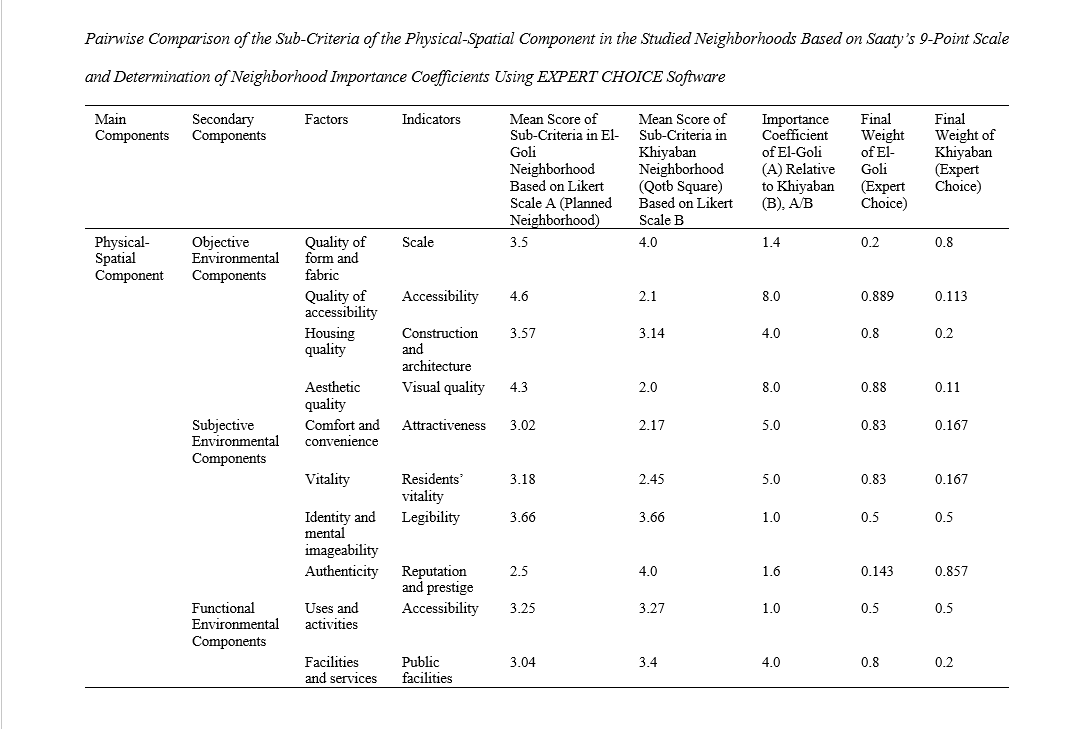
The present study aimed to evaluate the impact of sustainable architecture on reducing environmental pollution and improving energy efficiency in residential buildings through a comparative analysis of physical-spatial and environmental components in selected urban neighborhoods. This study employed a mixed-methods approach combining qualitative and quantitative analyses to assess sustainability indicators in two neighborhoods, El-Goli and Khiyaban, in Tabriz. Data were collected through structured questionnaires, expert interviews, field observations, and document analysis. The Analytic Hierarchy Process (AHP) was utilized to determine the relative importance of criteria and sub-criteria related to physical-spatial and environmental components. Pairwise comparison matrices were developed using Saaty’s 9-point scale, and the data were analyzed using Expert Choice software to compute weights, priorities, and consistency ratios. The evaluation framework included indicators such as accessibility, housing quality, environmental cleanliness, air quality, infrastructure efficiency, and resource management. The results indicate that the El-Goli neighborhood demonstrates significantly higher performance compared to the Khiyaban neighborhood across both physical-spatial and environmental components. The relative weight of the physical-spatial component for El-Goli was 0.723, compared to 0.277 for Khiyaban, while in the environmental component, El-Goli achieved a weight of 0.766 versus 0.234 for Khiyaban. The consistency ratios of the AHP analysis were below 0.10, confirming the validity of the comparisons. Mean scores of environmental and physical-spatial indicators were also higher in El-Goli, indicating superior environmental quality, better infrastructure efficiency, and improved spatial organization. The findings confirm that the application of sustainable architectural and urban planning principles significantly enhances environmental quality and energy efficiency in residential areas, and the superior performance of the El-Goli neighborhood highlights the effectiveness of integrated design, modern infrastructure, and sustainable resource management in achieving these outcomes.
References
Abbaszadeh, Z., Hagh Lesan, M., & Ebrahimi Asl, H. (2022). Simulation of Residential Buildings with Different Architectural Components Toward Optimizing Energy Consumption in Tehran City (Case Study: District 1). Geography (Regional Planning), 12(4), 430-448. https://www.jgeoqeshm.ir/article_162869.html
Farnam, S. M., Naghdi, M., & Jahanifar, F. (2022). Investigating the Effect of Cost Reduction Methods as a Factor Influencing Sustainable Management of Construction Projects Tenth National Conference on Civil Engineering, Architecture, and Sustainable Urban Development of Iran, Tehran. https://www.jgeoqeshm.ir/article_162869.html
Harischian, M., Naghibi, H., & Shari Zadeh, A. (2019). The Role of Solar Energy in Reducing Energy Consumption and Environmental Pollutants in Residential Uses (Case Study: Tehran). Renewable and New Energy, 6(2), 124-133. https://www.jrenew.ir/article_87959.html
Hosseini Mansoub, F., & Barar, F. (2023). Investigating the Effect of Sustainable Building Architecture on Energy Consumption Third International Conference on Architecture, Civil Engineering, Urban Planning, Environment, and Horizons of Islamic Art in the Second Step of the Revolution Statement, Tabriz. https://civilica.com/doc/1959187/
Jamei, A., & Zaman, A. (2020). Sustainable Architecture and Its Impact on Reducing Building Energy Consumption. Modern Research in Geographical Sciences, Architecture and Urban Planning, 28(3), 113-134. http://noo.rs/2mfkp
Murathan, E. K., & Manioğlu, G. (2025). Impact of urban form on energy performance, outdoor thermal comfort, and urban heat Island: A case study in Istanbul. Energy and Buildings, 116109. https://doi.org/10.1016/j.enbuild.2025.116109
Najarnezhad Mashhadi, M., & Zafari, M. (2023). Investigating Sustainable Materials with an Economic Approach Sixteenth International Symposium on Advances in Science and Technology, Mashhad. https://civilica.com/doc/2019698/
Nasri, J., Nikousefat, H., & Esteki, M. (2023). Investigating the Approach of Renewable Energies and Sustainable Architecture Toward Controlling Environmental Pollution Tenth International Conference on Civil Engineering, Architecture, and Urban Planning, Tehran. https://civilica.com/doc/1816536/
Rahaei, O., & Poursiah, Z. (2022). Investigating the Climatic Performance of Solar Chimneys for Houses in Ahvaz in South-Facing Sunlit Rooms. Iranian Architecture and Urban Planning Journal, 13(23), 245-257. https://doi.org/10.30475/isau.2022.221907.1365
Rieksta, M., Brumana, G., & Bazbauers, G. (2025). Transforming Non-Residential Buildings: the Role of Subsidies and Sustainable Energy Consumption.
Saadat Jou, P., Alizadeh, A., Jahanbakhsh, S., Mohammadkhorshiddoust, A., & Sari Sarraf, B. (2024). Comparison of Building Energy Consumption Under the Influence of Climate Change in Different Cities of Iran. Geography and Planning. https://geoplanning.tabrizu.ac.ir/article_17939.html
Sasan, A., Behbahani, R., & Ebrahimi Asl, H. (2023). Development of Sustainable Architecture and Double-Skin Facades: The Application of Double-Skin Facades in Reducing Environmental Pollution and Preventing Energy Loss. Journal of Islamic Art Studies, 20(50), 282-309. https://www.sysislamicartjournal.ir/article_149470.html
Sharston, R., & Singh, M. (2025). Urban morphology, urban heat island (UHI) and building energy consumption: A critical review of methods and relationships among influential parameters. Building Services Engineering Research & Technology, 01436244251339727. https://doi.org/10.1177/01436244251339727
Sheikh Louie Bonab, V., & Sheghaghi, S. (2022). How to Form a Sustainable Residential Building Using Smart Materials in the City of Tabriz. Journal of Islamic Art Studies, 19(47), 303-318. https://www.sysislamicartjournal.ir/article_150276.html
Tamimi, S., & Farhang. (2025). Management of Construction and Creation of an Intelligent Energy Production System for Buildings Utilizing Available Renewable Resources. Pars Project Management, 1(1), 124-150. https://jpm.pu.ac.ir/article_721751.html
Tootonchi Aval, S., & Nik Nemat, N. (2021). A Study and Examination of the Role of Buildings in Carbon Production and Greenhouse Gas Emissions in England Seventh Annual International Congress on Civil Engineering, Architecture, and Urban Development, Tehran. https://elmnet.ir/doc/21215120-21861?elm_num=1
Vaisi, S., Ahmadi, N., Shirzadi, A., Bahrami, B., Shahabi, H., & Mahdavinejad, M. (2025). A comparison between different machine learning techniques for predicting heating energy consumption for residential buildings in a cold climate. Energy Efficiency, 18. https://doi.org/10.1007/s12053-025-10379-1
Vitalii, S. (2025). Energy Efficiency in Architecture: Modern Strategies for Optimizing Energy Consumption in Residential Buildings. Universal Library of Innovative Research and Studies, 02, 12-16. https://doi.org/10.70315/uloap.ulirs.2025.0201003
Xia, T., Ali, A., & Mahyuddin, N. (2025). Multi-Objective Optimization of Window Design for Energy and Thermal Comfort in School Buildings: A Sustainable Approach for Hot-Humid Climates. Sustainability, 17, 8646. https://doi.org/10.3390/su17198646
Downloads
Publication Timeline
- Submitted
- Revised
- Accepted
Issue
Section
License
Copyright (c) 2026 Yosef Asadi Khanegah

This work is licensed under a Creative Commons Attribution-NonCommercial 4.0 International License.